Showing posts with label Nepal. Show all posts

Monday, April 6, 2009

Happy Holi!

(3.23.08)

Holi is the full-moon springtime festival of colors celebrated in India, Nepal, and neighboring countries. On this day, people come out and throw colored powder and douse each other with water. Some use water guns to spray each other with colored water. (Air can relate because in Thailand they also use water guns on New Year's Day). This year the Holi falls on March 22 (Saturday). According to Mukti, the "hilly people" of Nepal celebrate it on this day, while the Terai people (and the people of India) celebrate it the day after. We're in the Terai, but since a lot of hilly people have settled here, we were guaranteed to see some action.

We had a deadline for our preliminary report at 7pm, so we set out early in the morning to give us enough time to finish writing after lunch. Yep, we decided to watch the festival, and possibly participate as well (Air wore a plain shirt and jogging pants, just in case. I did not intend to join so I didn't dress down.) Mukti said Butwal would be the best place to find people doing the Holi, so we drove for almost an hour from the Hokke hotel in Lumbini to reach Rupandehi's biggest city.
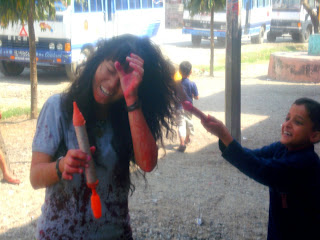
Upon reaching Butwal, we first stopped at a store selling colored powder. There were kids throwing powder at each other and splashing each other with water. Air immediately joined the kids, running around like crazy. Air was so into it that in no time she looked like a huge mess, her shirt and pants (and hair) wet with colored water. I managed to avoid the powder. I just wasn't in the mood. The people were laughing and clapping as Air ran after the kids (and vice versa). Good thing I asked the hotel for a clear plastic bag to cover my camera with because I knew it could get wet.

After that, we drove further until we reached the hills. It was my first sight of Siddhartha Highway, a scenic route that is almost 200 kilometers long that weaves through several districts including Palpa and finally Pokhara (more on them in later entries). We came upon a group of young people who had set up a road block. They wanted to put Holi powder on us and to ask for donations. They were friendly, if a bit stubborn about the donations. We tried to shake them off until Mukti asked for 10 rupees. Air opened her window and threw powder at one of the guys and they laughed. Another group involving old folks wearing colorful clothes sang and danced for us, and even asked Air to join them.


As we went on, we were stopped by at least three more groups asking for money. It seems they were really letting nobody pass without getting money, although I saw a guy in a motorcycle just zoom past. I got irritated and nearly lost my cool. I thought, hey, you cannot coerce people into giving you money. I mean, in the Philippines, people also do this, but not this much, certainly not a few minutes apart in the same highway. And a no is a no. And I know that this seems to be common in Nepal. I feel it's like institutionalized coercion. Young cadres of the Maoist party of Nepal have been known to block roads and trekking trails to ask for specific amounts (I read they even issue receipts, and if you don't pay, well the next collector will ask to see your receipt, so if you can't produce one, then you have to pay him).

We stopped at a roadside teahouse at the edge of a cliff. The air was crisp and the view amazing, reminding me of Tagaytay in the Philippines. There were other tea shops around, selling yummy-looking food. The place seemed a popular stop for buses and other travelers. At the side of the road, an ancient-looking water spout shaped like a lion's head gave out water continuously, where people washed their hands and faces.

On the way to the city, we were stopped again several times by groups asking for money. I got so irritated that I just closed my window and paid no attention, pretending to understand what I was trying to read. I don't know if it's because of the age gap, but I was also a bit upset that Air seemed to be so into this merrymaking that I felt my blood rushed to my head when some green Holi powder flew into my direction when she was trying to horse around with some of the people outside. I didn't mean to be rude, but all I could think about was finishing our report and not getting powder on my clothes. I swore Holi's not my favorite festival in the world.

We made it back to Hokke at around 1 pm. After taking a shower and putting on fresh clothes, we started with our report. I felt we took too much time already so we had to work.

Around 3:30 pm, there was a knock on the door. We were being invited by the hotel staff to eat something at their quarters to celebrate the Holi. Air and I looked at each other and said, okay, 10 minutes, because we're in a hurry.

Upon reaching the quarters at the back of the hotel, we were immediately met by a bucket of cold water and several pairs of hands putting Holi powder on my face! Nyaarrgh! And I'd just taken a shower and was wearing a new, white shirt!?! I was definitely taken aback, not just by how messy I now looked, but also by how happy everyone seemed, which was infectious. It's not unlike when Filipinos celebrate the feast of St. John the Baptist and people just go nuts splashing water at everybody, all with a sense of fun. I tried to escape from more buckets of water and more Holi, to no avail. Air started running around doing the same to everybody. My camera got wet so I gave it to one of the staff to put it somewhere dry. After several more minutes of craziness, we were given delicious food and drinks and posed for group photos. Air thought the celebration was the perfect ice breaker: after that, they were no longer faceless hotel staff. They became our friends. And my new white shirt, now soiled with colorful Holi powder, will remain unwashed for eternity, the perfect souvenir of this unbelievable day.

The celebration didn't end there. In the evening, after e-mailing Kathmandu our report at 7:30 pm, we were invited to join the staff for drinks and music. Under the full moon, we ate Nepalese snacks and drank whiskey and San Miguel beer (go Pinoy!). The staff also invited a group of senior Japanese pilgrims and a couple of Russian guys who were also staying at the hotel. One of the staff, Sachindra (Sachin for short) -- who tends the hotel shop and who strangely looks Spanish because of his Caucasian features (he is a Newari, from the city of Patan; more on that later) -- started singing some Nepali songs with his guitar. He said he plays with his friends in a band in Kathmandu. But to my horror, he called me and asked me to sing something. Yikes, I don't really sing in public in the Philippines, certainly not with Japanese and Russian people around. He gave me a "songhits" with Nepali and English songs. I knew one song there, the Beatles' "And I Love Her," so I mustered up the courage to sing that, which surprisingly went ok. Next to sing was a couple of Japanese ladies, and then it was dancing time, with the cooks and the gardeners giving their all, Bollywood style!

After a quick tour of the kitchen (where they gave us more food), I sneaked back to our room at around 10:30 to call it a night. Mukti and Bhimji followed. Mukti was worried about Air being left alone with the other guys at the party. I told Mukti that I'm sure Air will be fine and I didn't think anybody would do anything bad to her. (You see, Nepalis retreat to their homes quite early, with shops closing at around seven. And women certainly don't stay out late, unlike where Air and I are from where people start coming to clubs at 11 pm. Although Mukti may have had a point, as I learned the next morning that some of the guys got drunk). I appreciate Mukti's concern, but maybe he's just not used to young women staying out late. Air meanwhile thought Mukti acted weird.


(Click on any image to see more photos.)

Saturday, March 21, 2009

Kapilvastu

(3.23.08)


We stayed in Lumbini to do observation work in the district of Kapilvastu. We wanted to stay in Taulihawa, the center of the district, but there's just no suitable accommodation available. A local observer suggested that we rent a house instead, but we thought it's too much of a hassle since we'll be staying in the district for several days only. So we decided to just stay in the Hokke hotel, which is about 17 kms (45 minutes) away from Taulihawa.

Compared to Bhairahawa, Taulihawa looks very rural. There is a small commercial area where basic necessities are sold. There are also several shops selling traditional clothes. I bought myself a complete Madhesi get-up: a long-sleeved shirt that extends down to my knees, white drawstring long pants, and a white cotton scarf (which Fernanda really liked so I also bought her one). Air had a field day buying an armful of colorful dresses from a sidewalk stall, she attracted the attention of a crowd of guys of all ages. I noticed that people were selling by the gram powders of different colors. People usually use this for the tika (that red or yellow dot on the foreheads of Indians and Nepalis), but now they're buying it in bundles in preparation for a certain festival.

We also noticed this donkey in the town center. No, he doesn't do anything, he just stands there. Sometimes we see him in the shade, but still just standing there, with eyes closed. Very funny.

One of the funniest sights was a "school bus" being pulled by a rickshaw (or to be exact, a "school rickshaw"), which looked like a small cage, but with children inside instead of chickens!

Kapilvastu is also said to be a significant place for Buddhism because this was the Buddha's hometown, where he grew up before he got his calling. There are supposed to be archaeological sites near Taulihawa but we have not been able to look for them due to lack of time.


(Click on any image to see more photos.)

At peace in Hokke

(3.20.08)

The Lumbini Hokke Hotel is located right smack inside the Lumbini Development Zone, a huge, generously funded Buddhist complex (in Rupandehi, Nepal), which is (or will be) probably to Buddhism what the Holy See is to Catholicism. The hotel is in the northern part of the Zone, a stone's throw away from the World Peace Pagoda (more on the Development Zone in a later entry). A room in Hokke is not cheap, but since budget permits it, we took two rooms, one for Air, and one for us guys. We got a discounted price, the NGO price. Hokke has a strange pricing system: a room is priced less if more people will share it (Air's room, though smaller, is actually a bit more expensive); you pay less if you're a Buddhist pilgrim, but you pay more if you're from the US or Europe (which means you'll probably get the best deal if you're an Asian pilgrim with a group). Come to think of it, maybe all hotel rooms should be priced this way.

There are only 16 rooms in Hokke, which come in two styles: the Western style, and the Japanese style. Of course we took Japanese-style rooms. It was love at first sight. The rooms are immaculately designed, and very comfortable. In other words, you know where your money goes. My first reaction upon seeing our room was, where's my camera? Tatami floors, sliding paper panels, minimalistic furnishings. They even provide Japanese robes for all guests, and complimentary green tea. A Japanese bath is also available for free use by tour groups.

The grounds are well-kept, and the ambiance nothing short of tranquil, perfectly suited to Lumbini. There are ponds at one side, a prayer and meditation area at the back. Just outside the grounds is a crane sanctuary. Two beautiful peacocks roam freely in the grounds, especially in the morning when they make the strangest sound, like a cross between a truck horn and a really loud fart!

The hotel is also supposedly known for its Japanese dishes, but I've not tried them because they're probably very expensive. The fabulous complimentary continental breakfast is enough proof that they serve immaculate food. They even bake their own bread.


(The Hokke is my favorite hotel in Nepal, and the staff are some of my favorite people in the country.)


(Click on any image to see more photos.)

Saturday, March 7, 2009

A passage to India

(3.19.08)

Nepal's most popular border crossing to India is in Bhairahawa, in the village of Sunauli about 10 minutes from the city center. We decided to go there on a lark late in the afternoon to check the area out, after a trip to Butwal, Rupandehi's biggest commercial area (more on Butwal later). Nepal shares a porous border with India, meaning citizens of both countries can come and go as they please without documents. This is the reason why the Terai is very India, because there are many Indians who have chosen to live here, plus the fact that the Terai used to be part of India, before Nepal became the nation that it is now. In fact, one can be forgiven to think that Nepal is still part of the subcontinent. Turn on the TV and you'll see Bollywood and Indian channels. Look at the people, their physical features, the way they dress. Most Nepalis can understand and speak Hindi. Indian currency is accepted in Nepal, and Nepalese currency accepted in certain parts of India. Hinduism. The caste system. The food, the cows and goats. And the current Indian Idol, Prashant Tamang, is Nepali.

The Terai has many problems unique to it because of its proximity to India. Several Indian terrorist groups sow fear in the Terai, and they reportedly operate from across the border. At least three of these groups have threatened to kill (or might have already done so) candidates and party members, and even observers for reasons I still don't know.

(Then there is the problem of the Madhes. The Madhesis claim to be the original inhabitants of the Terai, with strong ties to Indians. From what I've understood, they want the Terai to be a separate state, complaining that they have suffered discrimination from the hill peoples of Nepal who have descended on the Terai for greener pastures. The Terai is a strip of fertile flat land from east to west, where approximately 50% of Nepal's population currently reside. They started settling in the Terai some time in the 1950s if I'm not mistaken, when the area became a safe place to live in after the government did some serious fumigation to drive away malarial mosquitoes. Up to that point, most of the settlers in the area are the Tharus, a group of Southeast Asian-looking people who are said to have a natural immunity to malaria. They can still be found in some of the most rural of villages in the Terai, living in their traditional mud huts. We've met some of them, and it's actually quite cool inside them huts.)

Less than a kilometer from the border crossing, Mukti advised us to close the car windows, hide our cameras, and not to say anything. I think the idea was, if we would act natural, nobody would notice that we were actually foreigners. We can probably pass as Nepalis and cross the border without problem, but we did not want to take any chances and jeopardize our stature as international observers.

There's a big possibility that we won't be allowed to cross, but really, all I could think about was stepping on Indian soil, my dream country, visited on a lark one afternoon.

We parked the car a few meters from the border, just close enough to take a photo (sshh.) of the Welcome To India sign. Wow. Can I just run from here? Mukti got off the car and crossed the border to talk to the border police about the possibility of letting us in since we are international observers. Bless Mukti. He did it! He got permission for us to go in, but on two conditions: we can only go in for a short distance, and strictly no cameras.

Our car started to go in. The place was chaotic. Lots of trucks coming in and going out. Cars, vans, rickshaws packed with people and their belongings. Small shops everywhere selling Indian stuff: textile, food, newspapers, household goods, underwear! The noise. The density of people. I was loving every minute of it. I was really tempted to whip out my camera but Mukti kept reminding us that we were given a special favor, a privilege, so we better not break the rules. Sucks. We drove for a kilometer into India. (Into India!) How I wish we could drive further. A short distance from here, there's a bus that could take people to New Delhi in less than 24 hours. My fantasy was to make a side trip either to Tibet or to New Delhi after the mission, and also to visit Agra where the Taj Mahal is. But Tibet is an impossibility, and I read that it takes forever to get an Indian visa in Nepal. The best way to get a visa to India is to get it from one's own country, for bureucratic reasons. We were already far from the Indian police (whom I like to refer to as the Bollywood police with their big bellies, funny mustaches, and greenish brown uniforms, just like in the movies!), so I asked Mukti again if I can just take one picture; he agreed, and I managed to shoot a bajaj, proof that we did cross the border as there are no bajajs in Nepal.

At this point, all I could think about was to get off the car, plant my feet on Indian soil, and maybe kiss the ground. We went back to the border crossing, put on our observer IDs, and felt the ground on our feet. I'm in India! Let's shop. Air promptly disappeared into one of the textile shops. I hung around for a while in the shop but there was nothing for me there. In fact, it seems that all the shops here do not have traditional Indian stuff for guys. All the textile shops cater to women, with so many varieties of textile for saris, and accessories like bangles, bracelets, bindis, and the like. Finally, I saw a shop selling scarves similar to what the Indian men in their bicycles wear. I bought two. There was also a store selling Indian shoes. I've always wanted to have a pair of those Mughal-style shoes with curls at the toes. Yep, finally I got one, a little too big for me though, but it was the closest one and it's either I buy it or go back to Nepal with only two Indian scarves.

We were looking for Bhimji and the car and realized that he had parked at the Nepal side, so we started walking towards the gate. The prospect of just walking into another country thrilled me. Just before actually crossing, yep, I whipped out my camera with Mukti's approval and took photos of us under the Welcome To Nepal sign. (We also took photos of illegal Maoist campaign propaganda, but more on that later.)


And just like that, it was all over.

(More photos.)

Observing elections

(3.18.08)

So I'm here in Nepal to observe the parliamentary election. Before I left Manila, I already blogged about why people do it, but you may ask how it is done. Long before election day (1-3 months prior), the accredited international monitoring organizations, like the Asian Network For Free Elections (Anfrel), The Carter Center, and the European Union (EU) send long-term observers (LTOs) out to (if possible) all areas of the country. Let me backtrack a little. Take note of the word "accredited," as the election commission of the host country has to officially invite each organization. Once this is done, each organization then selects which people to invite as observers, based on experience and other qualifications. After that, the host election commission will then officially approve of and issue an ID for each international observer. Only upon approval by the election commission can the observer be certain that he/she can come to the country and do the job. For this election, Anfrel has 20 long-term observers. A week before election, more than 80 Anfrel short-term observers (STOs) will arrive, making the Anfrel delegation the biggest to observe Nepal's election, with more than a hundred observers and staff from about 30 countries.

Right. So during the pre-election period, LTOs, usually teamed in pairs and accompanied/assisted by local partners, will then go around all the areas assigned to them, interviewing people from the government, the political parties, candidates, teachers, the local media, community leaders, youth groups, and ordinary citizens, to get a sense of the pre-election environment. The goal of the LTOs at this stage is to come up with periodic reports about their areas, which will then be submitted to their headquarters in the capital for analysis and synthesis. The headquarters will then come out with periodic press statements leading up to election day. These statements are then picked up by news agencies like the AP and CNN, and reported to you at home in addition to what their reporters have gathered on their own. Since it is also the main goal of election monitoring organizations to assist the election commission of the host country to hold a free and fair election that will adhere to international standards, these press statements and reports will also contain recommendations for the government and political parties, which they will (hopefully) accept and follow.

For many stakeholders, the mere presence of international observers is enough. If people are aware that their activities are being observed by foreigners: a) they gain more confidence in the system and will be encouraged to go out on election day to vote; and b) in the case of potential troublemakers, they will think twice or suffer the indignity of being documented and perceived negatively by international organizations, especially in Asia where locals tend to give more importance to what international observers have to say.

About ten days before E-day, the STOs arrive. Prior to their arrival, the LTOs book their hotels, cars, interpreters, etc., anything to make their stay comfortable, as they don't really have time to do these things. Generally, in my observation, STOs tend to be older, the academic-types, or the too-young type with less experience in this sort of activity (I started out as an STO). STOs also tend to be less adventurous than LTOs, so LTOs see to it that they don't feel inconvenienced during their short stay out in the field, or else they'll be breaking down our necks, or worse, say negative things about their experience at the headquarters, even if unwarranted. (I should know. In a previous mission, one STO complained in the capital that the vehicle I booked was not a four-wheel drive. We were far from civilization. Near the jungles. And she was expecting a four-wheel drive.)

Anyway, the STOs -- also in pairs, or individuals paired with one LTO -- will then be assigned to their own specific areas. We are assigned to observe the Lumbini Zone, comprising six districts, so we expect at least five more STO teams to arrive here in our zone so that each district will have its own Anfrel team. The STOs will then do practically the same thing, hopefully interviewing more people than what the LTOs were able to cover during their stay in the area, and covering/documenting campaign rallies. This is essential because the situation can change a week or mere days before the election, especially right around the end of the campaign period. Each STO team will then come up with a report, so if the headquarters used to receive only 10 field reports, they will now be swamped with about 50, and have to analyze (decipher?) each and synthesize in record time (I'm glad I was never part of the staff), and then come up with a press statement a day or two before E-day, right when the political parties have (supposedly) stopped campaigning.

On election day, each team will go around their assigned area, observing the conduct of the election from when it opens at around 6:30am, to when ballot boxes are transported from the polling booths to the counting center (usually way after sundown). Since observers will only have a few hours to cover 10 to 20 polling booths, it is essential that the observers plan their route very carefully, choosing which booths to visit with the help of maps and in consultation with other foreign observer groups, and (this is very important) actually visiting each booth at least the day before. I had a nightmarish experience in Indonesia in 2004. The day before the election, my interpreter and I decided to change the route due to reports of irregularities in one area, so of course we didn't have time to do proper reconnaissance. On election day, our car got stuck in the mud for hours, near the forests of Papua (Irian Jaya) for crying out loud, notorious for armed separatists, not to mention possible wild animals and gigantic mosquitoes. No, that will never happen on this mission. On that historic day in Indonesia's history, we were able to cover a grand total of five polling booths. (Not for naught. Almost all of the five were incredibly interesting.)

So on election day, observers go around the area, with checklists in hand about whether the correct procedures are being followed, and other questions pertaining to the location of the polling booths, etc. After the polls have closed, the team will then summarize their findings, to be immediately passed on to the headquarters, who will then call the teams one by one (whew!) to confirm their report and get other information verbally, for the organization's election day report which will have to be released that same night.

Usually, STOs will have to fly back to the capital the very next day for de-briefing and assessment. The LTOs are then left to observe the counting. You may ask why the international observers leave just when the potentially more crucial part of the election has just begun. You see, this is where the local election monitoring organizations come in. They usually don't have enough resources to mobilize people prior to election day, but on E-day and thereafter, they are present in the polling booths and counting centers.

After the counting, ideally the LTOs (or at least some of them) will remain in their areas for up to a month or so more, going around their area once again and talking to some more people, to get a sense of how the process and the results are perceived/accepted by the people. This is also the time when the different stakeholders will complain (or sour-grape), depending on the performance of their party or organization in the polls.

Throughout this whole process, it is essential that the observers maintain their impartiality. Impartiality can be a big challenge, especially to local observer groups, since they will have to recruit as many volunteers as possible in a very short time, and infiltration by political parties is not unheard of.


So here we are, the Lumbini Zone LTO team:

a. Me, Paolo Maligaya from the Philippines. This is my third international election observation experience, after Sri Lanka in 2001 (with Anfrel) and Indonesia in 2004 (with the Carter Center);

b. Air (real name: Chompunut Chalieobun) from Thailand. This is her second election observation experience, after serving as interpreter in Thailand in December (with Anfrel);

c. Our interpreter, Mukti Nath Adhikari, who heads his own NGO in Kathmandu called Prosperous Nepal, is alligned with some other youth groups, and is also an accredited observer for NEMA (National Election Monitoring Alliance);

d. Our driver, Bhimraj Tamang, or Bhimji for short. He can't speak English. We'd love to talk to him, but can't; and

e. Our vehicle, a Toyota Qualis. If this thing breaks down, we won't know what to do (hire a rickshaw perhaps?)


(Team photos). (Our car).

Friday, March 6, 2009

Watching life pass by in Bhairahawa

(3.18.08)

The flight from Kathmandu to Bhairahawa was short, about 20 minutes only. In the Philippines, I'm used to flying over seas or green forests, but here in Nepal, you fly over brown hills. Scary, what if we crash... Just a couple of weeks ago, a UN helicopter crashed in one of these hills, killing several people. Looking down, there's no way anyone could survive... I can't imagine living in a country without a beach, having lived in Southeast Asia all my life where we almost take beaches for granted. I remember my first observation mission, in 2001 in Sri Lanka. I had a Nepali teammate. One day we went to the beach in Galle and he started collecting...stuff...to bring back home. He said he's collecting shells and corals for his aquarium. I glanced at the plastic bag he was holding; inside were really ugly shells, but I didn't have the heart to tell him. And some of those he collected were actually broken pieces of concrete.

Disembarking from the small plane, I could feel the difference. It was warm. It was like being back in my country after a quick trip to Kathmandu. I wasn't sure whether to feel happy that it felt like home, or to feel cheated that I got to go to Nepal and not feel as if I'm in a different country. Silly thoughts. Inside the small airport, Air and I were met by our interpreter, who immediately led us to our waiting car in the parking lot.

From the car, I could see that Bhairahawa (pronounce it without the "ha") is a city that is not very urbanized. In fact, it looked quite rural with its brown fields, and cows and goats roaming the dusty streets.

We were first billeted at Pawan Hotel. I thought it wasn't very good, but we were told that tour groups prefer this hotel. It's not even mentioned in the newest edition of Lonely Planet Nepal, though it was mentioned in Air's copy, an older edition. Later I proved once again that Lonely Planet should not be trusted too much. It listed down another hotel nearby as "the best in town;" when we moved there a few days later, the rooms were atrocious, with crusty old carpets and lights that won't work. I think the best hotel in town is Hotel Yeti. When we visited it, we wondered why we did not check it out earlier. It was barely mentioned in Lonely Planet. The hotel though is right smack in the center of town, probably not the most secure location at a time like this.

Bhairahawa is indeed a small city, but a charming one. I'm loving it more and more as the days pass. No, the fields aren't brown, they're golden, the wheat ready for harvesting. Driving through these wheat fields, I can describe the atmosphere as pastoral and bucolic. Being so close to India, the place is very India. I've always dreamed of going to India, and have watched documentaries about the country, and I can say that Bhairahawa, and indeed the rest of the district of Rupandehi, fulfilled that dream for me. People in traditional clothes working in the fields, long-horned cows pulling wagons of hay, traditional mud huts, cow dung being dried, bricks being baked in the middle of the fields... It is a place living in the past, not in a hurry to modernize. (Later I would realize that the same thing can be said about the rest of the country.)

The city proper can be aptly described as laid back and breezy. Women in their colorful saris with red tikas on their foreheads, shopping for colorful textile at the small roadside shops. The sound of bicycle bells from the colorful rickshaws plying the streets, trying not to bump into the cows that seem to own the place. Men in their long-sleeved white shirts and scarves riding their gloriously vintage bicycles. Street vendors selling freshly-squeezed fruit juices, yoghurt drinks, local ice cream and dumplings. Small tea shops and sweet shops (misthan bandar) full of customers, sipping milk tea and eating freshly-cooked samosas or fabulous Indian sweets while discussing politics. From a hotel window, I even saw a guy doing yoga (as his dog looked on) at the rooftop of the next building.

There's so much to appreciate, to see, to taste, to smell, to hear, to feel. Bhairahawa reminds me why I love being able to travel: traveling heightens my senses, opens my heart, and stimulates my mind. (Of course, another reason is it enables me to get away from the monotony and cruelty of daily existence. Screw life. Hail life.)


(Click on any image to see more photos.)


Hanging out outside Kasturi, my favorite restaurant in the city.

Bhairahawa by day:


Bhairahawa at night:

Monday, March 2, 2009

Get set

(3.15.08)

The Asian Network For Free Elections (ANFREL) will deploy 10 long-term observer teams all over Nepal, with two international observers for each team. I will be sent to Lumbini Zone, the lower half of the Western District of Nepal (the upper half--where Tenzing will be deployed--includes Pkhara, Mustang, and Gorkha). The Lumbini Zone consists of six districts: three in the hilly areas (Arghakhanchi, Gulmi, and Palpa), and three in the Terai area (Rupandehi, Nawalparasi, and Kapilvastu). I'm very excited about this assignment because it means I'll be able to go to Lumbini, one of the most important religious sites in the world being Gautama Buddha's birthplace. Looking at the map, the Zone is also a stone's throw away from the Royal Chitwan National Park, known for its elephant safaris and rhinos.

My teammate for this mission is Air, the Thai observer who gave me the map to Thamel. She is only 22, and this is her first mission as a long-term observer (she served as interpreter in ANFREL's mission in Thailand in december, to which I was invited but I declined as it coincided with Christmas.) Air and I immediately hit it off, and together we've started preparing for the mission. Our team will be based in the district of Rupandehi, specifically in Bhairahawa, several kilometers away from Lumbini which is also part of Rupandehi. When we arrive in Bhairahawa, our interpreter and driver are supposed to meet us at the airport.

More stuff to bring. Aside from the two folders, we were given maps, forms, vests, caps, stickers and flags for our vehicles, SIM cards, flashlights, raincoats and medicines. I was reminded of the kit given by the Carter Center a few years ago. Inside an Eastpak backpack were not only the usual stuff, but also chocolate chip cookies and chocolate bars!

* * * * *

The morning of our flight to Bhairahawa, I made a dash to Thamel around 8:30 to buy a digital camera. Make that two dashes as I had to go back to buy a Sony memory stick because the storage card from the old camera wouldn't fit in the new one, and I also found out they forgot to give me the instruction manual! It was quite stressful because it meant I had to negotiate with taxi drivers four times, and to finish packing everything before 11 am when we're supposed to leave for the airport.

Yep. I finally reached Thamel, not only twice but four times as Air and I had dinner there last night and did some shopping. I'm going to write about Thamel later. Right now, let's go to the Terai and get things going.

But what is the Terai? From what I've gathered so far, the Terai is the lower part of Nepal bordering India. Unlike the rest of Nepal -- the Nepal the world knows, which is hilly or mountainous and cold -- the Terai is mainly plains, where 50% of Nepal's population live, where most of Nepal's food come from, and an area that is very very hot. Reading some of the materials in our folders, and through the briefings, we learned that the Terai is a very problematic area when it comes to peace and order. There were reports of murders, a lot of them. Some Indian terrorist groups supposedly operate in the area. Most interesting. Where's the plane?

Catching up

(3.14.08)

It's the last day of the briefing. I had lunch with Fernanda at the hotel's poolside restaurant. I missed Fernanda. We had a great time together as a team when we were international observers in Indonesia for the Carter Center. She was one of the nicest persons in that mission, and we had a fun time in North Sulawesi, Gorontalo, and Bali. Prior to joining the Carter Center, she was already with the UNDP in Jakarta. In the few years that we didn't see each other (while I struggled in Manila -- see the rope burns), she finished her Master's in Lisbon, served in Mozambique and East Timor, spent time in Goa, and now she's been here in Nepal for almost a year with the UN. She has traveled around Nepal, even to Mustang Valley which remains inaccessible to cars (you can only reach it by trekking for several days -- I can't wait for the roads to be built, but I wish the culture will be preserved).

She said the country poses a lot of challenges, one of which is, of course, the terrain. She said some of the villages in the hilly areas are accessible only by helicopter, as they are located on the hilltops. I later learned that this is probably because the people wanted to stay as far away from the plains as possible, where malaria used to wreak havoc.

I asked Fernanda about what she doesn't like about Nepal, and she answered the caste system. Some people treating others like dirt. This is something that is not yet obvious to me, and I really don't know much about the caste system yet, but I'm sure as I spend more time here, I'll know what she's talking about.

The grind begins

(3.11.08)

Note received last night from the front desk: "This is your roommate Tenzing (Tibetan). We have only one key for the room, so if you are going out, please leave it at the front desk. I'm non-smoker & I would highly appreciate if you refrain from smoking inside the room. If If you are non-smoker -- then that's great! See you later. Tenzing."

Yep, non-smoker. Nope, my roommate is not from India but a Tibetan who lives in Afghanistan but has worked in India. And yep, Tenzing is a great person.

Today is the start of what is one of the most important, but my least favorite part, of any election observation mission: the briefing. Three days in a conference room, from early morning till evening, being briefed about a lot of stuff, from the political situation, to the election process, the political parties, to some nearly mundane things (as was the case a few years ago with another organization) like how to walk properly. Wha? These things are extremely important of course, but sometimes it gets really dull that you could sense that what everybody wants to do is just bust out of the room and be somewhere else, anywhere else. Oh there they are. The familiar sight of those two huge folders filled with information painstakingly put together by the staff, that we have to read and digest in the next two or three days, unless we want to go out in the field knowing zip about what we're supposed to do. By the end of the mission, they'll be suitcase fillers, which, I'm sure, I have to pay excess baggage for at the airport counter. (And I always bring all my folders home, because they've got information you can't get anywhere else really.)

For three days we will be meeting with the head of local and other international monitoring organizations, the Election Commission, the police, members of the media, and representatives from the UN. I was surprised to find a familiar name in the schedule -- my good friend Fernanda Lopes from Portugal, who's now with the UN in Kathmandu.

Sitting through the briefings will be an ordeal. Nepal is in the middle of a serious power crisis, with power outages a few hours everyday, which means that the aircon won't work perfectly the whole day; it became very hot earlier today that we had to open the windows. Only one elevator is working at the hotel, and this is considered a high-class hotel. What would be the conditions out in the field...?

Saturday, February 28, 2009

Arriving

Finally! Click "Nepal" under categories on the left to see the earlier entries. If you're reading this in Facebook, click "View Original Post" at the bottom. If you're reading this in Multiply or somewhere else, better head to www.paolospen.blogspot.com. There will be about 50 blog entries for this Nepal series (this entry is the fourth). Hope I finish before the year ends!

* * * * *

(3.10.08)

The first thing you notice when you disembark from your plane in Kathmandu is the air. For a Southeast Asian like me used to the humidity back home, the crisp midday air felt refreshing. I put my jacket on inside the plane, with thoughts of the snowy Himalayan mountains in my head. It wasn't that cold, but I'm thankful for my thick jacket.

Tribhuvan International Airport is a small-ish airport of red bricks. Definitely a far cry from the hustle and bustle of Suvarnabhumi, the airport reminded me a lot of the Soekarno-Hatta International Airport in Jakarta, in the sense that it was quiet, not very modern, brown, incorporates traditional architecture, and therefore quite relaxing and refreshing, like stepping into a resort. I saw only two duty free shops, one selling liquor and cigarettes.

Some of the guys lined up to get their visa on-arrival. I got my 60-day visa in the Nepal consulate in Manila, so I breezed through immigration.

The airport sits on top of a hill, offering a panoramic view of Kathmandu. My first impression was, oh, I'm really in a foreign country. I could see a sea of small buildings made of concrete and red bricks. Definitely not the Manila skyline. I could sense poverty, almost the same feeling I get when I see a panoramic view of Manila's slums, but this is definitely better because of the cold-ish temperature, which reminded me of a mountain resort.

After a longish wait for my fellow observers (mainly the Indonesians because Nepal has no consulate in Jakarta where they could have procured their visa), we boarded the van sent by Radisson hotel to take us to our home in Kathmandu.

It was no drive to paradise. The view from the airport was nothing compared to the chaos of Kathmandu's roads. The number of people on the road, the heavy traffic, the dust, the decrepit buildings now seen up close, people trying to get on very full buses, the narrow crowded streets, traffic rules not being followed. It was all a bit overwhelming. It reminded me of all those footages of India, specifically Calcutta (though maybe not as bad) I've seen on TV. We were caught in traffic a few minutes after leaving the airport, caused by a demonstration being dispersed by the police (we later learned it was an anti-China protest by Tibetans). Our vehicle took us through narrow streets lined with small grocery stores, laundry, kids playing. It did not feel like we were at the capital, the main city of a country. It was like, if this is the capital, then how would the other places look, knowing that I may be assigned to a far-flung, problematic area to observe the elections. Although of course, I also know that a country should not be judged by how its capital looks like (like how Manila is NOT the Philippines). After several more twists and turns through what looked like dense, residential areas, suddenly the van pulled up into a driveway. We're actually now at the hotel? Really? The surrounding areas didn't feel like, you know, a hotel district.

We were met by ANFREL's Nepali staff, who helped us check-in and gave us our schedule for the next three days. A certain guy from India named Tenzing will be my roommate, has already arrived but wasn't around. Seeing my room reminded me of how I (believe it or not) miss living in hotels. The last time I stayed in hotels for an extended period was four years ago.

After freshening up a bit, I decided to wander around the hotel. I remember a picture from the hotel website of an outdoor pool with a sweeping view of the Himalayas. I realized that, no, that's impossible, because the Himalayas seem to be hardly visible from this part of the city. I asked for directions from the front desk on how to go to Thamel, Kathmandu's backpacker district, which I know is very close to Lazimpat district where our hotel is located. I decided to take a walk. On the way out, I bumped into a Thai observer whom I met at the airport in Bangkok with an ANFREL staff member. She was kind enough to give me a card with a small map of the area.

It was around 4:30 pm when I set out for the city. I didn't bring any jacket along with me because it wasn't cold. A few meters from the hotel I started to cough. The air was dry, mixed with what I think is air pollution. There were not many people and cars along the tree-lined avenue. This part of the city is modern, the road lined with low buildings with restaurants and shops, especially near the hotel. At my left was an area with high walls, which I learned later on was the king's palace. I was fascinated by the people walking. Are they Indian? Are they Chinese? Some looked Southeast Asian. Most of the old folks were wearing traditional clothes, the old men with vests and traditional caps, and the women with thick shawls over their long dresses. It was fascinating and at the same time disorienting, as it became clearer that yes, I'm in a foreign land, and I'm the stranger with the strange clothes and mineral water bottle. Where the heck is Thamel? I kept looking at the map and was convinced I was going the right direction. Go straight then turn right at the second corner. I've been walking for twenty minutes trying to find the second corner. By this time I began to realize that not bringing the jacket was a stupid mistake. By 5pm, the temperature dropped noticeably, and I could feel goosebumps rising. I started coughing again. I finally reached a commercial area but it didn't look like a backpacker area to me. Where are the fancy restaurants? Where are the internet cafes and the mountaineer shops I saw on the internet? I saw an overpass. Finally the second corner! I climbed the stairway and crossed the street. What greeted me at the other side was blissful chaos.

Women in traditional clothes selling strawberries on the sidewalk. Narrow cobblestone streets bursting with people, cars, motorcycles, vendors pushing carts of produce, walled by red brick buildings up to four, five stories high, some with balconies, with shops, gazillions of them, selling shirts, fruits, vegetables, copper and brass wares, lots of jackets, shoes, shawls. It was exactly my fantasy Middle-Eastern bazaar made real. Music blaring from radios. Relentless noise from the vehicles trying to get out. A few meters laters I started hearing live music. A street band was playing. Is there a parade? A wedding? I continued to walk, a crowd of people going both directions, employees coming home from work, teenagers in uniforms coming home from school, local tourists, white people with sunburnt faces in their shorts and hats with mineral water bottles in hand. The smell of spices and incense filled the air. I came upon some sort of a square. There was this small temple wherein people were circling clockwise and then striking the small bell by the door. More vendors sitting on the ground, selling chilis and other exotic spices bursting with colors. Men and women in their stalls selling different kinds of incense, flowers, candles. Watch out for the renegade motorcycles coming this way, jeez they nearly sideswiped me. There were also these shops selling exotic paintings. Are those Chinese? They look like Buddhist paintings? But isn't Nepal Hindu? Lording over this area is a very high pagoda-style temple? What country is this again? A man came out of nowhere and approached me, asking for a ticket? What ticket? No, I'll just turn back, I said, it's not tourism day today. I turned back to see three narrow streets in front of me. Which one to take? Who cares, just pick one. Don't worry getting lost, just take a cab back to the hotel. I passed through more narrow streets, with throngs of people walking or buying food, household stuff, people-watching. I lost track of how many alleys I dove into, with more shops. Jeez, I know a lot of people back home who'll go crazy in a place like this, where so much stuff, exotic and cool stuff, are being sold. I then came upon another commercial square, this time bigger, with the stores a lot more Western-looking, but selling mostly traditional textile (from India?). Many women in colorful saris on this street. And is that a German bakery? Are those pretzels? Pastries! More strawberries being sold on the sidewalk. Taxi. Now. I could feel my feet complaining. I bet I could pass as a Nepali, but the mineral water bottle is a dead giveaway that I'm a tourist. No, traveler. How much, I asked. Two-fifty. (Don't give me that crap.) One-fifty. I'm sure that's still expensive but I really don't know how much the actual fare is so take me to Radisson. It was six o'clock.

At night, we had a welcome dinner at the hotel. The core ANFREL staff from Bangkok - Sui, Ichal, Song - were all there, as well as the other long-term observers from Myanmar, India, Bangladesh, and Pakistan (the group from Sri Lanka hasn't arrived, and there was still no sign of Tenzing, my roommate). My god are those gulab jamuns??!? With vanilla ice cream?!? I love gulab jamun, my favorite Indian desert which I buy at the grocery shop near the Sikh temple in Manila. I tried to convince my fellow observers to try this fab desert, with success. Mmm, a truly welcoming treat, and a perfect way to end my first day in Nepal. I'm excited with what's to come.

(Note: Yep, I did get lost and did not reach Thamel that day after all. I later realized that what I reached was the outskirts of Kathmandu's Durbar Square, or main square. What I thought was the first corner was actually the second corner. But who cares?)

Click any image to see more photos.


(PBA09o5o3p6o)

Monday, May 5, 2008

Transiting

(3.10)

Nightmare. I woke up on the day of my flight with a raging fever, sore muscles, and a dizziness that won’t go away. I’ve had a fever since Saturday morning (March 8), and the last minute panic shopping for things to bring and zipping across the metro in taxis for medical results and doctor’s appointments exacerbated it. The paracetamol would not work, though sweating in bed covered with a thick jacket in the Sunday heat did a miracle. By 5:30 pm, I was inside a cab on my way to the airport with my mom. Gosh, the old NAIA looked so crummy. As I unloaded my luggage at the departure area, the handle on my huge suitcase promptly came off. Terror at the Cebu Pacific counter because I feared I would exceed the baggage limit (P300.00 per excess kilo!). Unbelievably, it came down to only 21 kilograms. Whew! There was the usual long queue at the immigration. I was extremely hungry so I made a dash for the nearest money vacuum known as the airport deli, but three delis later, I still could not buy anything because all of them did not have change for my dollars (I blew my remaining pesos on the terminal fee) and the money changers at the airport did not have smaller bills also (why don’t you just close!). Six dollars later, I wolfed down a so-so beef pastrami and Coke Zero. I had to eat once more just before entering my gate, and I had to buy food for the flight because Cebu Pacific doesn’t serve any. By 9:45 I was inside the plane, and at 10:15, on my way to Bangkok.

Say what you will about Manila, but viewed from a plane at night, Manila looks like a mass of glitters that truly sparkles. Bangkok pales in comparison, or could it be because the plane doesn’t really fly over the city before it reaches the airport.

The new Suvarnabhumi airport looks fabulous from the outside, like a gigantic alien mollusk that just landed to take more people in to be brought to wherever dimension it came from. One thing about the airport though: they really make you walk. To get from point A to point B is to virtually tour the whole place, wherein you pass by duty free shops, restaurants, and giant golden Thai statues. I took a public taxi to the hotel at the outskirts of the city, where I will spend like five hours before my connecting flight to Kathmandu.


From my taxi and hotel window, Bangkok looked just like Manila, but maybe a little more polished. I did not see any temples yet on the way though. After a brief sleep, I woke up, took my breakfast of cold veg pizza which I bought in Manila, and met my fellow observers from Southeast Asia downstairs. Aside from me, Malaysia was in the house, so was Indonesia, Cambodia, and Thailand. Apparently, I was the last one to arrive; some of them arrived two days before and have already roamed Bangkok. Unfair! Malaysia, Indonesia, and Thailand have three or more delegates, while Rain from Cambodia and I have to represent our countries alone. No complaints there.

At 10:45am, our plane took off for Nepal, where I’ll be spending the next five or so weeks doing something I love. See you in a jiffy!

Dispatches from Nepal

I know I said I would blog my way through the Himalayas, blah blah blah, but guess what, the internet connection was really slow (cue sound of dial up here) that it would have been totally frustrating and just plain impossible to do that.

Well starting today (for the next month or so actually) I'll be publishing my travel journals. It will surely take time because I took more than a couple of thousand photos and I want to show them all to you through this blog. Imagine uploading all those photos from Nepal...

Take this journey with me again, will ya.

Friday, March 7, 2008

Essentials


My Mojos. My krama. My headphones.

They're all going with me when I fly to Nepal this Sunday (finally) to start a long-term observation mission for the April 10 constituent assembly election in Nepal. I was supposed to go last October when the election was supposed to be held in November, but it was postponed (for the second time) when the Communist party withdrew from the government. All's well for now, and barring any other major roadblocks along the way, the election, which will determine who will write Nepal's constitution as it moves away from a monarchical system, will (hopefully) push through as scheduled.

I've been invited to join the observation team of the Asian Network For Free Elections (Anfrel), as the only long-term observer from the Philippines. I have joined Anfrel before, in 2001, as a short-term observer for the Sri Lankan parliamentary elections. I met them again in 2004 during the Indonesian presidential elections (when I was with The Carter Center), and last year when their observers visited us at the Namfrel national tabulation center in La Salle Greenhills.

I'm really excited to go on this trip, not only because it's quite an important mission for a very significant event in Nepal's history, but also because, hey, it's Nepal. The Himalayas! Mt. Everest! Snow! (he he). I'll try my best to get on one of those planes that offer the spectacular Everest Experience tour through the mountain ranges. It will be the closest I'll ever get to the top of the world, people.

I'm also aware that Nepal is one of the world's top destinations for adventure travel. The tragedy is, I'm not into the outdoors. I'd rather get stuck in a museum or in an ancient temple, or immerse myself in the local culture, than hit the rapids or, heavens, trek and get dirty. I don't even own training shoes, but for this trip, I know I have to buy a pair. I can't even imagine traveling with only a backpack. A big backpack and a giant suitcase is more like it. I am also incapable of traveling light. I have to have at least two weeks' worth of clothes, outdoor and indoor, without repeating. Ok that's a bit exaggerated (a bit), but you get the picture. And since Nepal is a cold country (well, for me who's from the Philippines), I have to bring more stuff like thick jackets and other winter stuff. Check out the difference in temperature at the bottom of this page.

I won't be able to regularly update my Multiply site but I'll try my best to let you in on my journey, and also the observation mission, though as an international observer I'm not really allowed to divulge any of our findings until the organization has officially released them to the press. But keep coming back to this site for updates. I'll be blogging my way through the Himalayas.